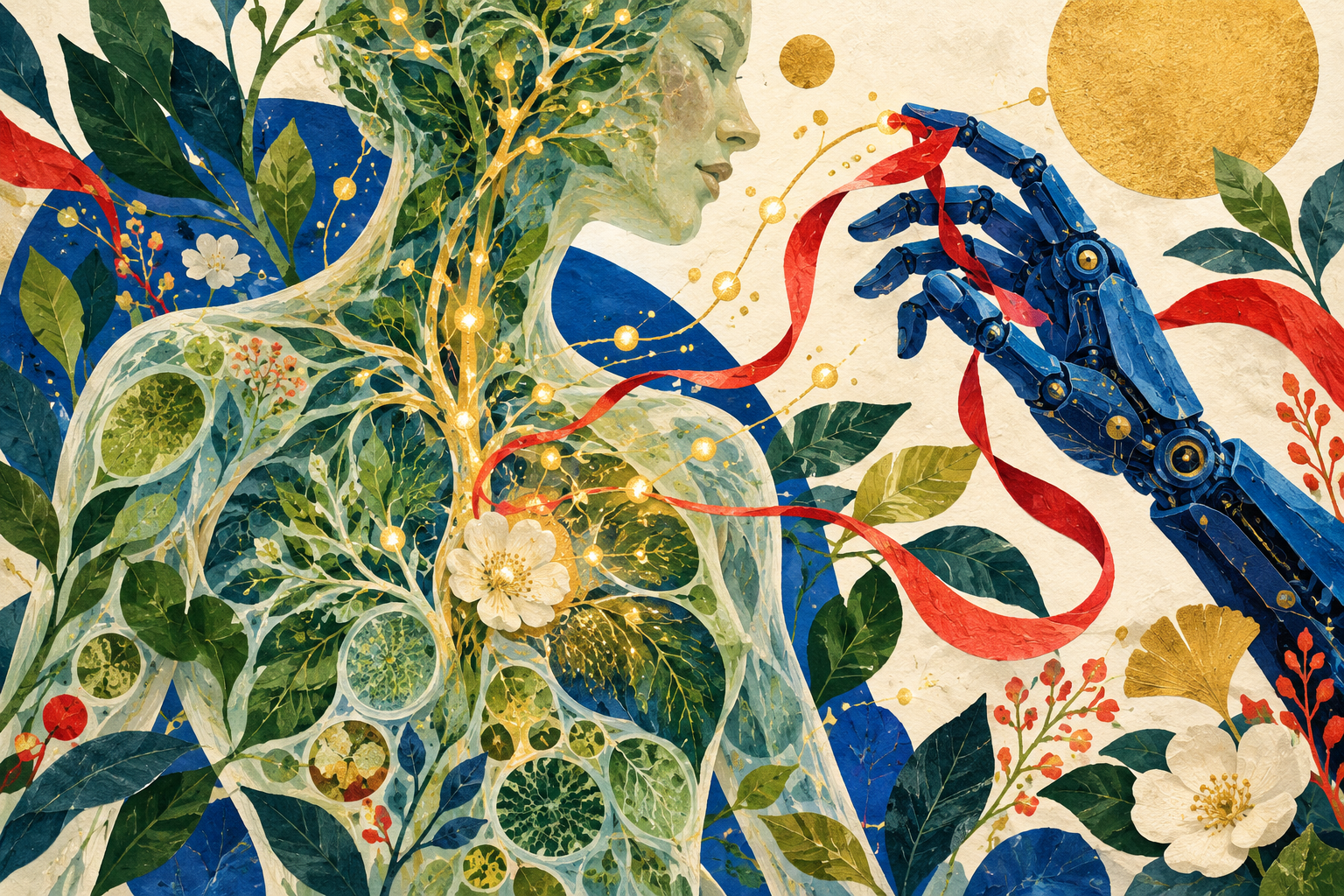
Perhaps one of our greatest mistakes in understanding the body is treating it as a silent machine.
A machine that can be measured, imaged, its components analyzed and its broken parts repaired.
But the body does not behave like a simple machine.
A small wound does not wait for a doctor to tell the cells what to do. Tissue immediately begins a complex sequence of changes: signaling, inflammation, cell movement, vessel formation, rebuilding, then stopping.
An embryo does not need an external engineer to place every cell.
After losing a portion within certain limits, the liver can recover much of its mass and function.
Organisms capable of regeneration can sometimes rebuild parts that have been lost entirely.
In every case, something happens that deserves attention:
The system does not merely change. It changes in a direction.
There is a present state.
A disturbance occurs.
A vast collection of local processes begins operating in ways that, with varying degrees of success, restore a particular structure or function.
This is no new philosophical discovery. Cybernetics was built around the idea that systems can use feedback to compare their present condition with a reference state and correct deviations.
Biology, however, makes the question far more complex.
We are not discussing a thermostat maintaining a temperature.
We are discussing billions of cells building, maintaining, and repairing an entire body, cooperating across multiple levels at once.
A question emerges that may become one of biology's most important in the coming decades:
How does a living system know what to return to?
The Signal Is Not Necessarily the Meaning
We know a great deal about how cells communicate.
There are chemicals.
Hormones.
Neurotransmitters.
Molecular gradients.
Mechanical forces.
And bioelectrical signals.
Bioelectricity, in particular, is no longer confined to nerves and muscles as many imagine. Almost all cells maintain voltage differences across their membranes. Increasing evidence suggests that bioelectric patterns participate in development, regeneration, and the regulation of tissue form. Research already examines how cellular networks store information about pattern and shape, and how manipulating electrical signals can influence broad morphological outcomes. [Reference to be completed: 1]
But we must distinguish signal from meaning.
Sound carries human language.
Yet language is not simply vibrations in air.
I can say the same sentence loudly or softly.
I can write it instead of speaking it.
I can translate it into another language.
The medium changes, while part of the meaning remains.
Could something similar happen in biology?
Are electricity, chemistry, and mechanical forces the language itself?
Or merely channels carrying something deeper?
The question is unresolved. There is no scientific evidence today for a “unified biological language” resembling human language.
But there is good reason to ask.
Developmental and regeneration research studies not only which molecule does what, but also how cells coordinate behavior toward large-scale outcomes, and how information about form and organization is stored and used across tissues. Laboratories such as Michael Levin's group at Tufts explicitly describe understanding morphological information, cellular bioelectric communication, and large-scale regulation of growth and form as central areas of their work. [Reference to be completed: 2]
The distinction matters:
Perhaps we are very good at measuring letters, while still not understanding the whole sentence.
The Body Does Not Operate on One Level
Take a simple example.
A cell has needs of its own.
It maintains its membrane.
Manages energy.
Interacts with its environment.
But within a multicellular organism, it is not a fully independent entity.
A cell may do something that does not benefit it individually because it serves the tissue.
The tissue serves the organ.
The organ operates within the needs of the whole body.
From one perspective, even cancer can be seen as a condition in which cells succeed locally at survival and reproduction while the result is disastrous for the organism as a whole.
The word “goal” is therefore insufficient on its own.
There are goals at different levels.
They may align.
They may conflict.
If we ever wish to communicate with biology, it will not be enough to say:
“Increase growth.”
Growth without context could be a tumor.
Or:
“Stop pain.”
Pain may be a necessary alarm system.
Or:
“Stop inflammation.”
Inflammation may be part of repair or defense.
A correct request must be more than linguistically precise.
It must understand the level at which the system operates and the larger goal to which it belongs.
Here AI Becomes Important in a Different Way
Most current discussion assumes AI will become a better tool for answering our questions.
Perhaps one of its most exciting future roles will be not answering,
but translating between levels the human mind cannot engage with directly.
Imagine a system simultaneously reading:
The electrical activity of cells.
Chemical signals.
Gene expression.
Mechanical forces.
The state of the nerves.
Immunity.
Blood flow.
And the tissue's prior history.
A person cannot hold all these variables in mind.
An AI system, however, can search for patterns among them.
Work already explores AI and computational models for understanding cellular and morphological control, including attempts to connect high-level descriptions to interventions in simulated cellular systems. These studies remain very early, but point in a clear direction: moving beyond describing components toward understanding how to control the collective behavior of living systems. [Reference to be completed: 3]
We can imagine a further step.
Not:
AI → commands the cell.
But:
Human intention → AI → translation into interventions and feedback loops → bodily response → AI reads the response → corrects the translation.
The interaction becomes a dialogue.
What If We Told the Body What We Wanted?
Imagine wanting to restore the function of an injured hand.
The naive approach would be to say:
“Repair the hand.”
But what does repair mean?
Its former shape?
Strength?
Sensation?
Fine movement?
Nerves?
Blood vessels?
Pain?
Do we return it to its state before the injury?
What if some tissue has changed in a way that makes a literal return impossible?
Human intention itself therefore needs translation.
AI's role might be to take a high-level goal:
“Restore normal function as far as possible while preserving the safety of the rest of the system.”
Then translate it into smaller goals at different levels.
But a problem precedes all this:
Does the body possess any representation of the state to be restored?
In some regenerative systems, cells seem able to produce organized structure despite major disturbances. This is one reason researchers study concepts such as “pattern memory” and large-scale morphological regulation. “Memory” here does not necessarily mean conscious memory or a tiny image stored within a cell. It is an attempt to understand how a distributed system repeatedly returns to a certain range of forms and functions. [Reference to be completed: 4]
We arrive at the most intriguing question:
Where does the “correct form” exist?
Perhaps nowhere in particular.
Perhaps it is distributed across a network of relationships.
Perhaps it emerges from the dynamics themselves.
Perhaps entirely new concepts are needed to describe it.
Perhaps the Language We Seek Is Not a Language of Commands
Perhaps it is mistaken to imagine a future in which we tell the body:
“Do this.”
A closer model might be:
“What are you trying to reach?”
Then:
“What is preventing you?”
Then:
“How can we help you complete the process?”
This radically changes medicine.
Instead of asking only:
What causes the symptom?
We add:
What is the system trying to do when it produces this symptom?
Of course, not every symptom is useful.
Not every disease is an “attempt to heal.”
Biological regulation can fail.
It can enter destructive loops.
Immunity can attack the body.
A cell can behave in ways that serve its survival while harming the entire organism.
Even these cases become more interesting if considered as conflicts among levels of organization rather than as a collection of independently broken parts.
What About Human Language?
Here we return to language.
If AI systems become intermediaries between people and the complex systems around them, language becomes a high-level layer for specifying intention.
The more powerful AI's capabilities become, the more linguistic precision matters.
“Remove pain” is not the same as “Treat its source while preserving sensation's protective function.”
“Increase growth” is not the same as “Restore the former structure while preserving natural growth limits.”
Natural language may become one of programming's highest levels.
Not because it executes things itself,
but because it expresses the goal, while intelligent systems translate that goal through thousands of technical and biological layers beneath it.
Our greatest skill would then be not knowing every equation the system uses,
but knowing:
What do we actually mean?
But There Is a Question Larger Than Technology
Up to this point, the essay can remain entirely within science.
Living systems use feedback.
Cells communicate.
Bioelectric signals help regulate growth and form.
There is real research in regeneration, development, and multilevel biological information. [Reference to be completed: 5]
If we ever uncover a deeper structure behind this process, however, a question will arise that science alone cannot settle.
If life contains systems capable of maintaining states, restoring patterns, and coordinating across levels...
What is the origin of this order?
Science can ask:
How did this mechanism arise?
How did it evolve?
What does the environment select?
How is information transmitted?
Which physical laws allow it?
These are fundamental questions.
A person may also ask a different question:
Why is there a world in which matter can organize into life capable of maintaining its structure, repairing itself, and behaving as though some states are better than others?
Here we enter philosophy.
Here enters the question of God.
Not as a gap into which we put what we do not know.
Not as the result of a laboratory experiment.
But as a question about the ultimate source of order, meaning, and purpose.
One person may see all this as the outcome of a long evolution of complex regulatory systems.
Another may see the very possibility of life bearing this organization as pointing toward a deeper order in existence.
A third may combine both, seeing evolution itself as part of a wider creation's workings.
Science alone does not compel any one answer.
But science may make the question deeper than before.
Perhaps We Were Not Looking for a New Language
Perhaps the greatest change will come when we stop thinking we will create a language that lets us control life,
and begin considering another possibility:
Life is already speaking.
Electrical, chemical, and mechanical signals may be more than noise inside a living machine.
They may be parts of a communication and regulatory system we do not yet fully understand.
AI may become the first tool able to listen to enough of these signals simultaneously to discover rules the human mind could not see.
The achievement would then not be:
“We taught cells what to do.”
But perhaps:
“We finally learned how to ask what they had been trying to do all along.”
The greater surprise might be that the language we discover did not begin with us.
Nor with AI.
Nor even with the first person who tried to understand it.
Perhaps it has been there since life itself began.
In that case, the final question would not be:
How do we write the language of life?
But:
Who wrote the first language?